Why are my bricks crumbling?
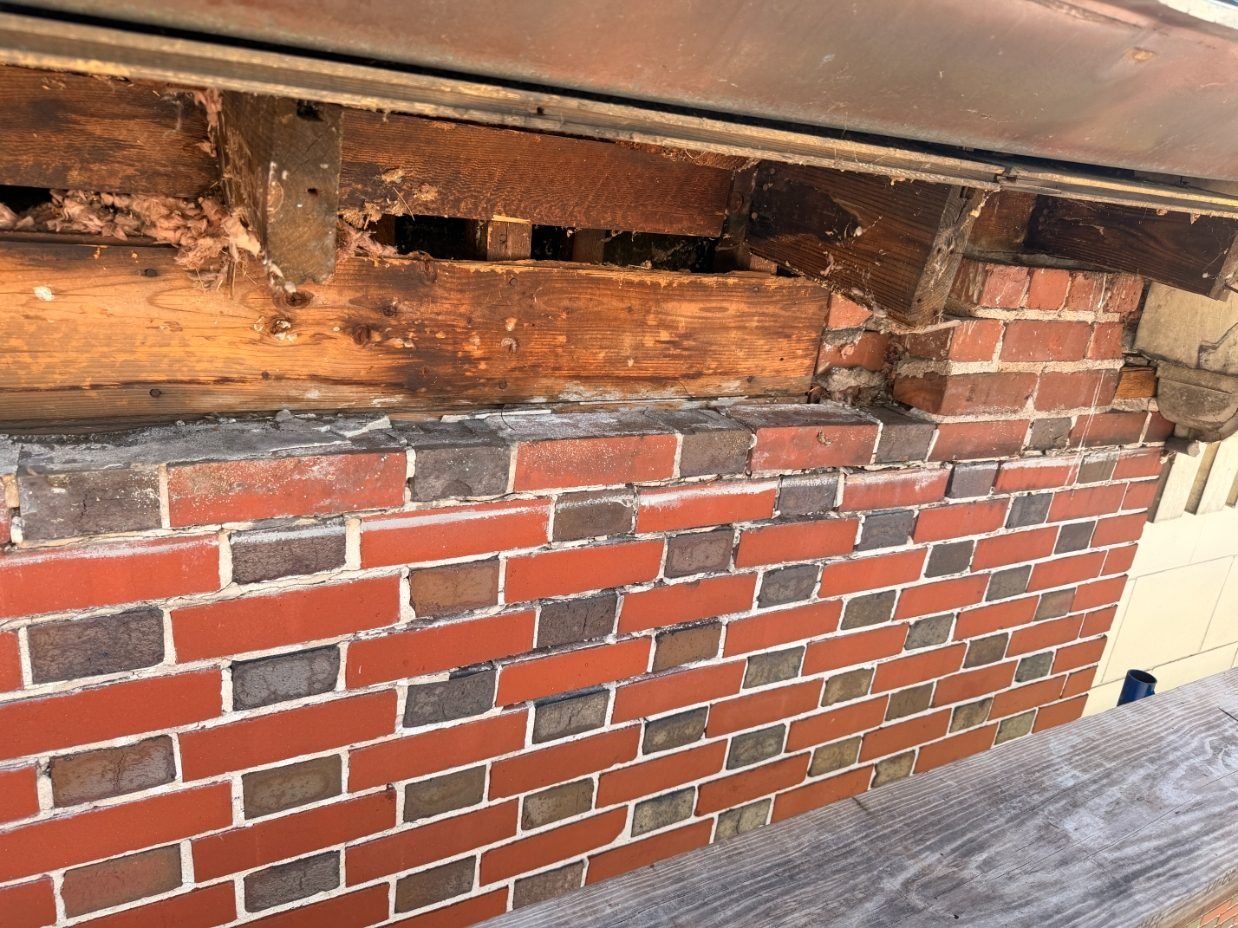
Almost always water plus cold. Brick is porous — it drinks water in, and in a New England winter that water freezes inside the unit. Ice takes up more space than water did, so it pushes outward from the inside until something gives.
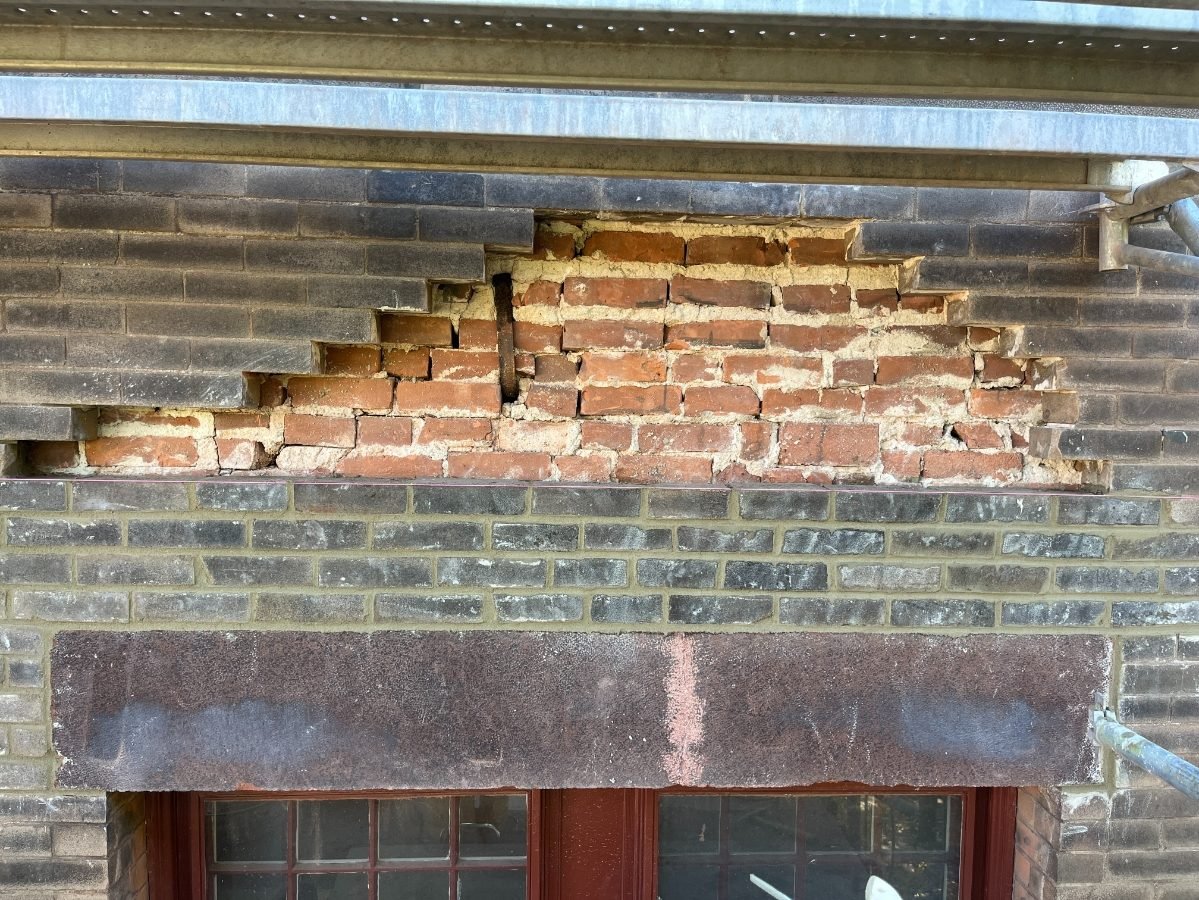
What gives is the face. Once the hard fired skin is gone, the softer body underneath absorbs faster, freezes harder, and the damage speeds up every season.
The other common cause is a repair done with mortar harder than the brick. When the joints cannot move or breathe, the brick takes all the stress and moisture instead. That damage looks identical from the driveway but it is man-made.
What is brick spalling?
Think of a brick as a hard-skinned sponge. It absorbs water through the face. When that water freezes it expands, and because it has nowhere to go it pushes the face off in a flake or a chunk. That is spalling.
You will see it as shallow dish-shaped craters, thin sheets lying on the ground below a wall, or a brick with a rough sandy face sitting between neighbors that still look smooth and fired.
Spalling is progressive. A spalled brick absorbs more water than a sound one, so it spalls again faster. It does not stabilize on its own.
Why are pieces falling off my wall?
Flakes and chips on the ground are spalled brick faces or failed mortar. Bigger fragments mean the freeze-thaw cycle has been running for several seasons, or that a coating or hard patch is trapping moisture in the wall.
Look up before you look down. Most of the time the water source is above the damage — a cracked crown, a full gutter, failed flashing, a cap with open joints — and the wall below is simply where it is showing up.
What causes brick to chip?
Freeze-thaw is the big one. After that: impact from mowers, snow blowers, and shovels along the bottom courses; de-icing salt splashed onto brick near steps and walkways; pressure washing that strips the fired face; and grinding done carelessly during a previous repoint, which nicks the arris of every brick along a joint.
Salt deserves a mention on its own. It gets carried into the brick with meltwater, crystallizes as it dries, and does mechanical damage very similar to ice. Sand grips just as well and does none of that.
- Freeze-thaw cycling in saturated brick
- Snow blowers, shovels, and mowers hitting low courses
- De-icing salt near steps, walks, and driveways
- High-pressure washing or sandblasting
- Careless grinding during an earlier repoint
Can damaged bricks be replaced individually?
Often, yes. Cutting out a failed unit and setting a new one in its place is standard work, and on a scattered handful of bad bricks it is exactly the right answer.
The unit gets carefully cut out without disturbing its neighbors, the pocket is cleaned, and the replacement is bedded and pointed in a mortar matched to the wall. On an older house we look for salvage or a close-matched reclaimed brick, because a modern unit next to century-old brick reads as a patch forever.
Individual replacement stops being the answer when the damage is continuous, when courses have lost bearing, or when the wall itself has moved. At that point you are rebuilding a section, not swapping units.
Are loose bricks dangerous?
Yes, and they should be treated that way. A brick you can rock by hand at the top of a chimney or on a parapet is a falling object waiting for a windy night.
Loose brick also means the mortar has stopped bonding, which means the section around it is carrying load it was not meant to carry. Keep people and cars out from under it and get it looked at rather than waiting for the next storm.
How much brick damage is too much?
There is no clean percentage, but there are honest thresholds. Scattered spalled faces on an otherwise straight, sound wall is repair work. Continuous damage across a whole elevation, crumbling that goes deep into the units rather than skimming the faces, or a wall that has bulged, leaned, or cracked in a stair-step pattern is rebuild territory.
The other test is whether the units still hold a fastener and still carry. When brick has gone soft all the way through, no amount of pointing around it helps.
Most walls we look at are a mix. The right scope replaces what is genuinely gone, repoints what can be saved, and does not quietly upgrade the whole wall to the bigger job.
Why do bricks pop or flake specifically in winter?
Because winter is when the water already in the wall turns to ice. Autumn rain saturates the masonry, the first hard freeze expands it, the thaw lets more water in, and the cycle repeats — sometimes dozens of times between November and March.
South and west faces often look worst because they thaw in afternoon sun and refreeze at night, which means more cycles per winter than a face that simply stays frozen.
The practical lesson is that the fix belongs in the fall. Sound joints, a good crown, working flashing, and clear gutters going into winter prevent damage that no amount of spring repair fully undoes.
Where to go from here
Brick repair and unit replacement sit under repair and restoration. If the damage shows up every spring, read winter, freeze-thaw and your masonry, and see the cost guide for what drives the size of a repair.
Trade-schooled and in the field every day across Spencer, Charlton, Worcester and the surrounding towns. Call or text (774) 420-9642, or send a couple of photos — a look costs nothing.
Tell us what's broken.
Send two photos. Get a straight number. Most estimates within 48 hours, across Central Massachusetts and the towns we cover.